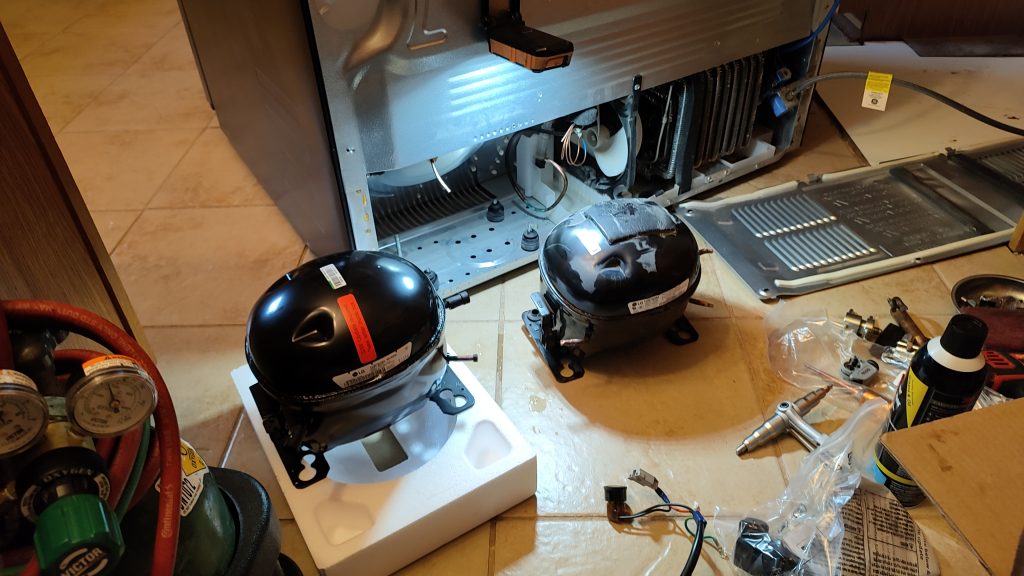

A quick honest note before we begin: this article will talk a little about EasyFix.
Yes, that means there is a small amount of advertising ahead. We are a business, and once in a while we have to explain who we are and how we work. Otherwise, how would anyone know?
But instead of telling you that we are “the best,” I would rather show you how the repair process works and let you decide whether it makes sense.
When a refrigerator stops cooling, a washer will not drain, or an oven stops heating, the appliance is only part of the problem.
Now you also have to decide who to let into your home, whether the diagnosis can be trusted, what the final bill may become, and whether the proposed repair addresses the actual failure.
Every company can describe itself as experienced, honest, affordable, and reliable. Those words sound good, but they reveal very little.
What matters is what happens before, during, and after the service visit.
Start With the Person Who Will Actually Arrive
EasyFix Appliance Repair is owner-operated.
I am Rustam Netesov, the owner and technician, and I have been repairing appliances professionally since 2013.
I review the appliance information before the appointment, arrive at the home, perform the diagnosis, explain the estimate, and complete the repair.
There is no unknown subcontractor assigned after the call and no chain of departments passing the job from one person to another.
That does not mean every appliance can be repaired in one visit or that every diagnosis is simple.
It means one person is responsible for understanding the problem and carrying the repair from beginning to end.
For many homeowners, that matters more than the size of the company.
The Model Number Matters Before the Visit
Before scheduling, we normally ask for the appliance brand, complete model number, symptom, error code, photographs when useful, and information about previous repair attempts.
That is not busywork.
Two appliances that look almost identical may use completely different control boards, motors, sensors, wiring, service procedures, and replacement parts.
The model number allows me to review available service information, parts diagrams, known failure patterns, and part availability before arriving.
It does not replace on-site diagnosis. It helps the visit begin with better information and fewer avoidable guesses.
A refrigerator described as “not cooling” could have a failed fan, an evaporator blocked by ice, a sensor problem, a control-board failure, hidden wiring damage, a refrigerant leak, a restriction, or a compressor problem.
The symptom begins the investigation. It is not the diagnosis.
A Confident Guess Is Still a Guess
Experience helps narrow the possibilities quickly.
After years of working on the same brands and designs, I may have a strong idea about the likely failure before opening the appliance.
But likely is not confirmed.
The longer I do this work, the less I trust absolute diagnoses made before the appliance has been tested.
“It is definitely the control board.”
“That model always needs a compressor.”
“We know exactly what it is from the error code.”
An error code, photograph, sound, or symptom may point the diagnosis in the right direction. It should not automatically become permission to install an expensive part.
Depending on the appliance, confirmation may require electrical measurements, service modes, wiring checks, pressure testing, temperature readings, visual inspection, or direct component testing.
The customer should be able to understand what failed and why the proposed repair addresses that failure.
Pricing Should Be Clear Before the Repair Begins
A low advertised service charge does not necessarily mean a low final bill.
- Service call and diagnosis: $120
- The $120 is applied toward the repair when the repair is approved.
- Minimum labor: $240
- Parts, shipping, and applicable sales tax are explained before the work proceeds.
The service-call fee is not magically erased. It becomes part of the approved repair total.
That is more accurate than saying the diagnostic fee is “waived,” as though the visit and testing had no value.
Before approving the work, the homeowner should understand what was diagnosed, what the repair includes, which parts are required, and what the expected total will be.
For a fuller explanation, see the EasyFix appliance repair pricing guide.
Sometimes the most useful result of a diagnosis is:
“The appliance can be repaired, but the repair may not make financial sense.”
That is still valuable information.
Real Repairs Say More Than Advertising
This is where I could repeat that EasyFix is experienced and thorough.
Real repairs say more.
A Completely Dead GE Refrigerator
One GE refrigerator had no light, no controls, and no compressor operation. It looked unplugged.
The actual failure was a power wire broken near a connector buried inside the insulated cabinet. The difficult part was finding the hidden break, routing a new line, and restoring the insulation and interior panel afterward.
A Built-In GE Declared Unrepairable
A built-in GE refrigerator had already been described as unrepairable because the required control-board path was unavailable.
The repair required restoring condenser-fan operation and rebuilding the feedback signal expected by the control system. It was not a standard board replacement.
A Samsung Ice Maker That Shifted Out of Position
In several Samsung Ice Master repairs, the rear of the assembly could move because the factory support tab had no usable mating point in the refrigerator cabinet.
As the ice maker shifted toward the wall, the opening available for falling cubes became smaller. Stabilizing the replacement assembly reduced the chance of the same mechanical ice stack returning.
Samsung and LG Defrost Relay Failures
On Samsung and LG refrigerators with frozen fresh-food evaporators, the complete defrost circuit could be tested from the main control board.
When the circuit was intact but the board did not supply approximately 120 volts during the defrost command, failed power relays could be confirmed and replaced without automatically purchasing the entire board.
These cases do not prove that every appliance can be saved.
They show how the decisions are made.
Parts and Second Visits
No technician carries every possible appliance part.
There are thousands of models and an enormous number of model-specific boards, motors, pumps, valves, sensors, ice makers, and mechanical assemblies.
A prepared service vehicle carries tools, electrical supplies, common materials, frequently used components, and parts selected for scheduled jobs. Many repairs still require a specific part to be ordered.
That is normal.
A second visit may also be necessary when the appliance requires a model-specific part, complete defrosting, sealed-system planning, a discontinued-part solution, or further testing after the first confirmed failure is repaired.
Everyone prefers a one-visit repair. I do too.
But promising that every appliance will be repaired immediately is not realistic.
The better standard is to complete the repair in one visit when practical and explain clearly when another visit is necessary.
OEM Parts Matter, but Diagnosis Comes First
OEM parts are often the right choice when fit, electrical characteristics, software, connector design, or safety requirements matter.
We use OEM parts when they are available and appropriate.
But an original part cannot correct a wrong diagnosis.
A new control board will not repair a broken wire elsewhere in the appliance. A new evaporator will not stop a refrigerant leak in the condenser. A new ice maker will not correct a failed heater-control circuit.
- Confirm the failure.
- Identify the appropriate repair.
- Explain the cost.
- Complete the work.
- Test the result.
The part comes after the diagnosis, not before it.
Repair or Replace Is Not Decided by Age Alone
An older appliance is not automatically a bad repair candidate. A newer appliance is not automatically worth saving.
The decision depends on the confirmed failure, overall condition, repair cost, replacement cost, parts availability, installation requirements, and likelihood of a dependable result.
A built-in refrigerator designed around kitchen cabinetry may be extremely expensive to replace. An older standard appliance may need one reasonable repair and continue working for years. A newer machine may have a failure expensive enough to make replacement the better decision.
A useful technician should be able to explain either conclusion:
“This repair makes sense.”
“It can technically be repaired, but I would not recommend investing this much money in it.”
The goal is not to sell every repair.
The goal is to make a decision based on the actual failure.
For a broader discussion, read Is It Worth Repairing or Replacing Your Appliance?
Three Promises Worth Questioning
No single statement proves that a company is unreliable. Still, three things deserve caution:
- A guaranteed diagnosis without testing
- A price that is not clearly explained
- An expensive part recommendation without an explanation of how the failure was confirmed
The cheapest initial visit can become expensive if the wrong part is installed.
The highest estimate is not automatically the most professional.
What matters is whether the diagnosis, repair plan, and price make sense together.
How EasyFix Normally Handles a Repair
Before the visit, we ask for the model number and a useful description of the problem. When practical, I review service and parts information in advance.
At the home, I test the appliance and explain the confirmed failure and available repair path.
The customer receives the estimate before the work proceeds.
When a part must be ordered, we explain why it is needed, what it costs, and what happens next. When another visit is required, we explain the reason.
After the repair, I test the appliance again.
The process is not dramatic. It does not promise that every job will be easy.
It is simply how appliance repair should work.
Frequently Asked Questions
Who performs EasyFix appliance repairs?
EasyFix is owner-operated. Diagnosis and repair work are personally handled by owner-technician Rustam Netesov, who has been repairing appliances professionally since 2013.
Why do you ask for the model number before scheduling?
The model number identifies the appliance design, compatible parts, service information, and known failure patterns. It helps us prepare but does not replace on-site diagnosis.
How much are the service call and labor?
The service call and diagnosis are $120. That amount is applied toward the repair when approved. Minimum labor is $240. Parts, shipping, and applicable sales tax are additional and are explained before the work proceeds.
Can every repair be completed in one visit?
No. Many repairs can be completed in one visit, but model-specific parts, heavy icing, sealed-system work, discontinued components, or multiple failures may require another appointment.
Do you always use OEM parts?
We use OEM parts when they are available and appropriate. A correct diagnosis still comes first because even an original part will not solve the wrong failure.
How do I know whether my appliance is worth repairing?
That depends on the confirmed failure, repair cost, condition of the appliance, replacement cost, parts availability, and likelihood of a dependable result. Those factors should be explained before you decide.
You Do Not Have to Take Our Word for It
You do not have to believe EasyFix is the right company simply because we say so.
Look at how the diagnosis is performed. Look at how the price is explained. Look at the real repair cases we publish—including failures that were unusual, difficult, or required more than one step.
Then decide for yourself.
That is a more honest way for us to advertise—and probably a better way for you to choose who works in your home.
The EasyFix team 🤝
No Upsells. No Nonsense. Just Honest Work.
📍 Serving Clark & Cowlitz Counties and the Portland Metro Area